On December 22nd, Consumer Reports said it could not recommend the MacBook Pro — a first for a Mac laptop. It caused a stir! Consumer Reports’ reasoning was simple: it got wildly inconsistent battery test results every time it tried to test multiple versions of the laptop. Its test is one that’s pretty common across the industry, loading up web pages one after another:
"For the battery test, we download a series of 10 web pages sequentially, starting with the battery fully charged, and ending when the laptop shuts down. The web pages are stored on a server in our lab, and transmitted over a WiFi network set up specifically for this purpose. We conduct our battery tests using the computer’s default browser—Safari, in the case of the MacBook Pro laptops.
In that test, CR saw the 13-inch MacBook Pro (with the Touch Bar) get results from 16 hours all the way down to less than 4 hours — again, wildly inconsistent. Similarly, the 15-inch version saw results range from a “that can’t be right” 18.5 hours down to 8 hours. Because the results ranged so widely, CR concluded that it’s not a good idea to buy this laptop until we know more about why these battery results are so inconsistent.
Yesterday, Apple’s Phil Schiller tweeted that the company itself doesn’t see anything like these results and is “Working with CR to understand their battery tests.”
That stir I referred to? It’s very real, and it happened mainly because the MacBook Pro was already at the center of very strong feelings amongst the Apple faithful. The laptops have not been as well-received as Apple might have hoped — for reasons ranging from dongles to processor power to price. You can add battery life to the list of things people don’t fully trust about the MacBook Pro now — especially after Mark Gurman reported in Bloomberg that Apple originally wanted to use some more advanced battery technology but had to fall back to something more traditional. Oh, and Apple decided that giving you an estimated “time remaining” time in the menubar was a bad idea and so pulled the feature from MacOS.
In short, this particular Consumer Reports battery test drama isn’t happening in a vacuum. Now, the going argument right now is whether or not its test is trustworthy. CR says it “tests hundreds of laptops each year, using identical procedures in highly controlled conditions,” presumably without varying results on those other machines. After Apple and CR hash out what happened with these tests, we will hopefully get more clarity about what is going on here.
he Verge also uses a looping website battery test, though unlike CR we use live data on the web. Because battery tests have a lot of variables, we don’t assume ours is objectively accurate in all cases — it’s better as a guide. In fact, every battery test should be treated more as a guide for what you might expect in real world use rather than an objective measure. The most diligent publications limit every possible variable to come to objective, comparable measures — work that is useful and laudable. But in the real world, the variables are infinite, so you want to do your best to describe real world results whenever possible.
In our review of the MacBook Pro with Touch Bar, we did both. Our looping battery test clocked in at 10.5 hours for the 13-inch model, but in real world (and not very intensive) usage, we got less than 6 hours of life on two different machines.
It’s too much to ask for objective, universally applicable battery life estimates. But it’s not too much to ask that these machines at least be a little predictable. Perusing 9to5Mac’s roundup of reviews, I’m sad to say you’ll find an equal number of reviewers suggesting battery life is an inconsistent question mark and others saying it’s in line with Apple’s 10 hour estimate.
Here’s one more result: in the three hours I’ve been awake today, the MacBook Pro (sans Touch Bar) has gone from 100 percent to 25 percent. But I have consistently had 15+ Chrome (a known battery hog, despite Google’s protestations) tabs open alongside Slack and Tweetdeck. In short: battery life varies and your results won’t line up with objective tests.
Whether or not the truth of the inconsistent battery results some are seeing on the MacBook Pro comes down to flawed tests, flawed software, or flawed hardware is unfortunately not something we can definitively say right now. What we can say is that it’s worth looking into. These are Apple’s flagship Macs, and the Mac’s reputation is built as much on trust as it is on finely milled aluminum.
The Chinese firm claims new technology will solve several 5G requirements.
Huawei released its X-Ethernet technology for “5G” bearer networks at the ITU-T 2020 FG Workshop and Demo Day Wireline Technology Enablers for 5G conference in Geneva, targeting the technology at integrated fronthaul/backhaul networks with deterministic low latency and end-to-end network slicing capabilities.
“In the 4G and ‘4.5G’ era, Ethernet is the dominant data bearer technology due to its simple, effective and low-cost characteristics,” Huawei noted in a statement. “In the coming 5G era, three key scenarios – [mobile broadband, massive machine-type communications and ultra-reliable low latency communications]– will set stringent requirements for bearer networks. Operators will need to satisfy 5G requirements such as fronthaul/backhaul convergence, service isolation and low latency in Ethernet while maintaining its existing advantages. That will pose a new challenge to the mobile bearer network domain.”
The Chinese vendor said the X-Ethernet solution solves the problem by offering features such as a layer 1.5 switch, hybrid multiplex and Ethernet end-to-end flexible hard pipe, adding the layer 1.5 switch is compatible with traditional Ethernet.
Huawei, as a member of the IMT-2020 Focus Group, participates in research on 5G bearer network technology, and that it’s open to collaborate with global partners, exploring Ethernet bearer network architecture and technologies to meet 5G requirements and develop new services.
Telenet, ZTE complete ‘Pre5G test in Belgium
Belgium operator Telenet and ZTE said they completed an outfield test of the vendor’s Pre5G technology, achieving 1.3 gigabit per second download speed in real network conditions.
Telenet is looking to complete the technology deployment in urban areas across Belgium by 2017, ZTE said.
“We’re very excited about the results of this test because the new speed record is a milestone on the way to 5G,” explained Telenet CTO Micha Berger. “The Pre5G networks are faster and provide higher capacity, improving mobile users’ broadband experience, especially in areas with high cellphone traffic.”
ZTE said the test was based on four commercial spectrum bands, and combined with Pre5G technologies including massive multiple-input/multiple-output antenna technology and 256 quadrature amplitude modulation.
The Company effectively Produced Blackberry's last 2 phones - the DTEK50 AND DTEK60.
BlackBerry has marked over (for the most part) worldwide rights to utilize its marking on telephones to Chinese maker TCL. The news takes after a declaration by the Canadian organization in Gregorian calendar monthwould stop making its own phones and concentrate and concentrate instead on services and software system.
Under the terms of the assention, TCL will "outline, make, offer, and give client support to BlackBerry-marked cell phones," while BlackBerry will contribute with the product and administrations. The arrangement is being touted as "worldwide," however there are a few restrictions: it won't have any significant bearing in Nepal, Bangladesh, Sri Lanka, India, or Indonesia. As indicated by Bloomberg, this is on account of Blackberry as of now has an authorizing assention set up in Indonesia, and is as of now taking a shot at another arrangement with an Indian organization. It's likewise fascinating to note this isn't TCL's first excursion at the purchasing outdated cell phone brands rodeo — it beforehand acquired Palm back in January this year (however never did anything with it).
The long and the shy of it is that any new BlackBerry telephone you ponder purchasing later on won't be made by BlackBerry. Yet, this isn't generally news when you consider that the last two BlackBerry telephones that went at a bargain — the Android-fueled DTEK50 and DTEK60 — were additionally made by TCL utilizing parts already found as a part of the Alcatel Icon 4. In our audit of the $300 DTEK50 we thought it was an adequate looking at the end of the day unremarkable gadget, clobbered by other Android telephones in a similar value extend. This most recent piece of news is truly simply the continuation of a well known story for BlackBerry. In 2009, the organization held 20 percent of the worldwide cell phone market; that is presently contracted to a scarcely recognizable 0.1 percent. As this arrangement recommends, the brand still holds a specific interest for a few buyers (or name acknowledgment at the extremely least), however as a phonemaker, the organization's keep going ceremonies were perused long prior.
Digital media is a mess, and Apple seems far from fixing it.
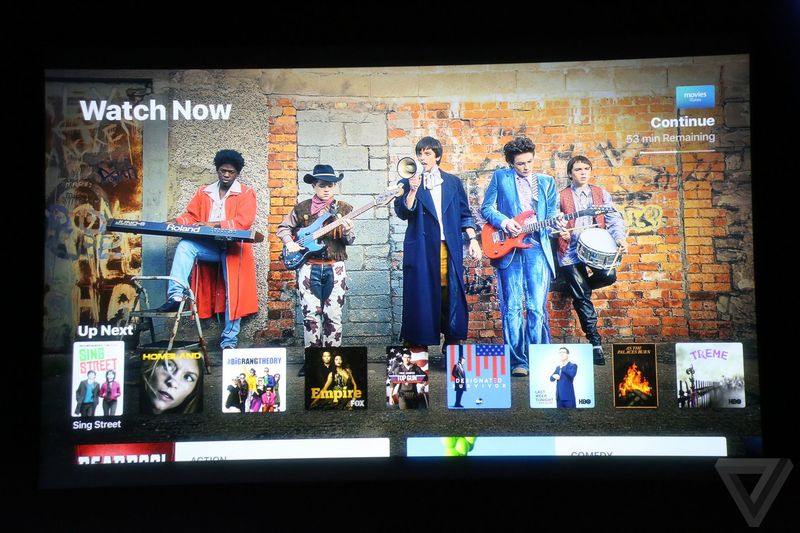
Apple’s latest attempt to crack digital TV arrived Monday in the form of a name change most consumers might not even notice. It’s simply called TV, and the new app replaced Apple’s Videos app with the release of iOS 10.2. It’s a neat addition for the iPhone and iPad, but it’s designed to shine on the Apple TV, where the app is supposed to hijack the interfaces and libraries of nearly every content provider available to offer a central location for all your TV needs. By opening TV, you can search for any show or movie, sync your many video accounts, and let Apple override the clumsy and disparate designs served up by other media companies.
But there’s a big problem. The TV app is neither what Apple really wants to deliver nor is it even a remotely suitable stopgap until the company can realize its vision for the future. Apple doesn’t have the support of Netflix or Amazon Video. The company’s single sign-on feature, which is designed to make it easier to use a cable subscription to sign into individual channel apps, only works with a handful of providers, excluding huge names like Comcast, Time Warner Cable, and Verizon FiOS. If Apple got its way, the TV app could be capable of upending the industry. Instead, it’s a reminder of how hamstrung technology companies arewhen trying to bridge the gap between our current app-centric world and a digital media future that’s deliberately kept out of reach by cable companies.
How we consume television is still undergoing rapid change — and it’s getting more complicated instead of simpler. As it stands today, consumers have shifted from cable, or never having cable in the first place, to a hodgepodge of different apps delivered over a dizzying number of hardware solutions. Perhaps you fire up the Netflix app on your smart TV, switch over to your Xbox One for HBO Go, or use the voice search function on your Amazon Fire TV to see if you can purchase the new episode of a show you watch that’s still gated behind cable. If you want a cable alternative, then you subscribe to AT&T’s DirecTV Now, Dish’s Sling TV, or Sony’s PlayStation Vue, which all exist as yet another app to download.
Apple’s new TV app is supposed to solve all that complexity by unifying all these fragmented services into a single, searchable system. It even gets mapped to the TV button on the Apple TV remote. But because it lacks real support from the most important players in the industry, it’s just another voice in the TV app cacophony.
Worse yet for Apple, it does not operate a streaming video service of its own and makes a set-top box that does nothing its competitors don’t already do, besides the robust games section of the App Store. It’s not for lack of trying. Apple has notoriously spent years trying to gain relevance in digital media, investing resources and countless failed software and hardware attempts to wrestle control away from content providers so it could offer its own solution. The TV app is just the latest potentially doomed attempt. That’s largely because it takes stellar ideas about how we should consume entertainment and smashes them against the immovable object that is the current video landscape.
This is a large source of pain for Apple. Nowhere is the iPhone maker less relevant — and yet so hungry to be in control — than TV. The company once dominated digital media by using iTunes and the explosive popularity of the iPod to control everything from how music was bundled and played to how television shows and movies were digitized and distributed online. But there’s no way cable networks are going to cede that much control to Apple in the new world of prestige TV, and there’s no way that the the Apple TV will ever give the company enough leverage to force a change like iTunes and the iPod did.
In the transition from CDs to downloads, Apple led the way and was always two steps ahead of its competitors. In the new streaming media world, Apple always seems like it’s two steps behind. iTunes, once a centerpiece of our media libraries, is now either ignored or openly disliked. And Amazon has popped up as a more capable replacement for movie and TV show rentals. Sling, Sony, and AT&T have figured out ways to release “skinny bundles” of TV channels over the internet.
You could write books on Apple’s multitude of missteps in TV, but fundamentally the company’s loss of influence traces back to missing the boat on streaming combined with an inability to gain any sort of real leverage over traditional video providers. Those companies have been able to forestall and deflect a fate similar to the one that befell the music industry in the heyday of iTunes, and that is unlikely to change in the near-term.
There is hope for Apple yet. The company is arguably the only player in a position to offer a democratic, holistic viewing experience that ties everything to a single source. Amazon, the company perhaps closest to that goal, makes both hardware and software. That means it tends to promote its own products over competitors’. Cable companies, too, are self-interested and prone to resisting change that could hurt their businesses. That means the products those companies produce, whether on-demand apps or live TV, are often ugly, hard to use, and rarely if ever play nice with others.
Apple could craft the ideal solution. It may not be the holy grail at first. But over time, it could take shape as a single iTunes-shaped app and streaming service that syncs with every provider. And if Apple could begin amassing a critical mass of users, it may gain the bargaining power to cut the live TV deals it’s always wanted — something like Sling or PlayStation Vue, except at a lower price and with an easy-to-use interface. Apple’s motivation here would be clear. By ensuring that this service only worked at its optimal level on the iPhone, iPad, and Apple TV, the company could again incentivize consumers to use only its software, instead of treat its devices as expensive screens for displaying video from elsewhere.
The TV app is the hollowed-out husk of that vision, waiting to fulfill its true potential. But Apple needs to convince streaming services like Netflix and Amazon to share their data and channel owners like CBS and NBC would need to compromise on the creation of an unprecedented digital TV bundle that could compete with cable. And the new TV app doesn’t not look like a must-use app that will give Apple enough power to force those companies to play ball in the way the iPod / iTunes combo brought the music industry to heel.
Apple’s most immediate fix is bringing Netflix and Amazon on board. Without those two companies and the data behind their extensive video libraries, Apple’s TV app remains broken. For instance, you can use the TV app’s universal search function to find a Netflix show like House of Cards, and you can even then pop over to Netflix to watch it. But you can’t sync your Netflix account with the TV app. That means your viewing habits and past behavior don’t get incorporated into the “Watch Now” panel.
This is important. Because when you think about it, most people would rather have what they want to watch surfaced easily before them then migrate to a search bar, type in the name of the show, and then click a link to a separate app. The amount of effort required to use the search function in Apple’s TV app in lieu of firing up Netflix makes it unlikely everyday consumers will change their habits. If Apple can’t convince viewers to migrate out of third-party apps, its software will be nothing more than a glorified TV guide that’s used sparingly or not at all.
The other option for Apple is to just give up on this aggregation app model and simply launch its own, proper streaming TV service.
Sony, Dish Network, and now AT&T have all stepped in to offer their own take on the cable alternative in the form of a skinny bundle that starts around $20 a month and scales up to nearly four times that, when you toss in sports and other add-ons. These are imperfect solutions, grounded in acquiescing to content providers’ more forceful licensing demands. They also give consumers only a slightly less frustrating way to watch cable without installing a box in their home and paying for channels they won’t watch.
The interfaces of these apps are messy, and there are significant restrictions in how live TV can be viewed in certain regions and on mobile devices. DirecTV Now, which AT&T launched late last month, hasn’t been able to convince CBS to come on board. That means it offers a pay-TV service that doesn’t have some of the most popular programming in the country.
Apple’s efforts in this area have been even less successful. According to anin-depth report from The Wall Street Journal in July, Apple tried and failed to strong-arm its way into lucrative licensing deals that would have allowed the company to offer a digital TV service unlike any we’ve ever seen. It did so by relying on the tactics perfected by execs like Eddy Cue and wielded years ago when Apple first began hammering out licensing deals with record labels
According to the WSJ, Apple’s top negotiators tried demanding a multi-year freeze on monthly rate per viewer fees, liberal use of ad-skipping and cloud DVR technology, and wider access to global rights for streaming outside the US and locate affiliate deals for providing regional programming. Apple also refused to show content providers its proposed interface, saying simply that it would be “better than anything you’ve ever had.” The negotiations, which took place from around 2009 to 2014, fell through.
It turns out that TV, unlike music more than 15 years ago, is still not in a place where Apple can alter the industry on its own terms. In the meantime, we’ll continue to use imperfect solutions to the problems that keep streaming services from replacing cable. If Apple somehow figures out how to convince companies desperate to maintain profits and preserve relevance to take a chance on the future, it could turn its TV app into what it was meant to be.
But right now, the only difference between Apple’s position today and where it was a year ago is its new glorified TV guide, one consumers will wish was more capable and forward-thinking than the cable companies will let it be.
After transitioning its curved screen from an experiment to a standard feature at the top end, Samsung is reportedly working on foldable phones. Two foldable phones are said to be in the works at Samsung, with one model scheduled for launch in 2017. Samsung Electronics is working on a 'dual-screen' smartphone that has flat screens on both side as well as a phone with single flexible OLED display, as per a report by Etnews. The company has been tipped to produce a small amount of dual-screen smartphones in 2017 in order to gain user response from the market.
The dual-screen smartphone features two flat displays on each side and even though the panel doesn't bend itself, there is a hinge between the two displays that allows for the smartphone to have a foldable design. Once completely folded, the displays will be inside, and no longer visible. On the other hand, the other foldable smartphone, which is expected to come after the dual-screen phone, is tipped to sport a panel that itself bends, and will result in a device with a display on both front and back when completely folded. As it will feature a truly foldable display, the phone will understandably require a much advanced hardware.
The dual-screen smartphone features two flat displays on each side and even though the panel doesn't bend itself, there is a hinge between the two displays that allows for the smartphone to have a foldable design. Once completely folded, the displays will be inside, and no longer visible. On the other hand, the other foldable smartphone, which is expected to come after the dual-screen phone, is tipped to sport a panel that itself bends, and will result in a device with a display on both front and back when completely folded. As it will feature a truly foldable display, the phone will understandably require a much advanced hardware.
Notably, Samsung has already given us a glimpse of its 'in-foldable' smartphone that sports a foldable display panel inside the smartphone. Quoting an expert from the industry, the report said, "In-foldable Smartphone is seen as a first type of a foldable Smartphone. Out-foldable Smartphone is the next step of in-foldable Smartphone."
In the out-foldable smartphones, the panels work even at the point where it is bent, Etnews points out. Interestingly, Lenovo showcased its own flexible displays at its Tech World 2016 event earlier this year in June.
Samsung has earlier been tipped to unveil two smartphones with bendable displays at MWC 2017. Some reports have further suggested that the company's timeline for the launch of its foldable smartphone was impacted by the global recall of its Galaxy Note 7 smartphone
Manufacturing industries in the United States rely on the tireless efforts of factory employees—who work daily to make, package, prepare and deliver the products we find on our shelves.
And there's a lot of physical effort required of factory workers. The strain of repetitive motion can lead to various musculoskeletal injuries, such as carpal tunnel syndrome or tendonitis in the wrists, arms and shoulders. Risks of injury not only cause workers to suffer, but can create massive inefficiencies for companies themselves, through hidden costs such as workers' compensation, lost time and reduced productivity.
"We want to solve these problems before people get hurt," says Rob Radwin, a professor of industrial systems of engineering at the University of Wisconsin-Madison. Radwin has been studying this problem for more than two decades, and with the advent of technology, he may be able to create a solution that is easy, efficient and economically viable.
Existing methods for measuring risk of injury leave much to be desired: Health and safety professionals often make subjective judgments of risk based on a 0-10 scale of hand activity. Although these measurements provide fairly reasonable predictions, there is immense room for error in human observation, and such conclusions require valuable time, expertise and training in ergonomics and safety. It also requires following the nuanced actions of many individuals over a long period of time. Current technology may be the key to facing, and ultimately fixing, this issue.
Radwin and his students are collaborating with Yu Hen Hu, a professor of electrical and computer engineering at UW-Madison. They already have developed computer vision algorithms to calculate hand activity level, funded through exploratory grants from the National Institute for Occupational Safety and Health (NIOSH) and the National Institutes of Health. In September 2016, Radwin received additional three-year funding of $1.4 million from the NIOSH Centers for Disease Control and Prevention.
This new grant will allow Radwin and his colleagues to use videos collected from a variety of institutions—among them, UC-Berkeley, NIOSH, and the State of Washington Department of Labor and Industries—to develop an entirely new measure for assessing health outcomes. This measure will use their video footage to visualize and track repetitive motions—establishing pattern recognition at which the hand demonstrates repetitive movements, grasps and exertions. By combining their recent epidemiology findings with this new measurement, they can create a basis for engineers to measure risk for injuries and redesign certain jobs in the workplace.
Rob Radwin. Credit: University of Wisconsin-Madison The ultimate goal is to not only create functioning, accurate measurements, but to make them widely accessible to companies via computer vision. This is where smartphones come in.
"I envision an app, and I think all the technology we need exists on my smartphone today: a high definition camera, a high-speed processor, and the ability to do cloud computing," he says.
If Radwin can apply his measures to a smartphone application, manufacturing employers could assess risk of injury of their employees with relative ease. This would involve simply pointing a handheld video device, which is less intrusive and time-consuming than existing methods, such as attaching an instrument to a worker's arm or hand.
"We can program phones to measure motions and quantify them in a way that is not only more accurate than the current method, but also automatic and more objective and reliable," he says. "It's not just for big corporations using ergonomics to cut costs—it would allow medium-sized and small businesses to access this technology as well."
Combining the assets of multiple disciplines—electrical and computer engineering, industrial and systems engineering, and biomedical engineering—Radwin's research will help companies make often simple, but impactful changes to high risk jobs. The measurements can assess factors such as speed—for example, if a worker is struggling to keep up with a conveyer belt, they may have to move their arms and hands faster to keep up, leading to fatigue and potential injury. New measures would be able to pinpoint such hazards, so employers could figure out how to engineer things like excess speed out of the task. Sometimes problems like these require relatively minor fixes, such as limiting the distances that a worker has to move objects so they won't be forced to move too quickly.
"Sometimes it's not obvious until you try and break down the task into its components," Radwin says.
However, by looking at existing videos of worker motions, Radwin can use the same concept to ensure that these problems don't arise in the first place. "Now we can understand how to look at various factors in a job, and try to engineer out hazards before individuals are even involved. That's our goal, and the goal of companies today, to do it right the first time."
Details of HTC next’s flagship smartphone have seemingly been leaked on Chinese social media, potentially revealing the upcoming handset’s hardware.
A mysterious tipster has posted a roster of specs – and a render image – of what they claim is the HTC 11, an unannounced HTC smartphone expected to launch next year. The details were posted to China’s Weibo microblogging service, and eventually lifted by Western media. But before we dive into the tipped specs, it’s important to remember that although Weibo often churns out solid leaks, it’s also very unreliable – it’s basically China’s Twitter, after all. We have no way of verifying the below information, so it could be a complete hoax.
According to the leak, the HTC 11 will feature a 5.5-inch QHD display. That would be a slightly larger screen than the 5.2-inch panel used on the HTC 10, although the resolution remains the same.
It’s also suggested that HTC will adopt the Snapdragon 835 processor, a new chip that was announced by Qualcomm just last month. It hasn’t appeared on any smartphones yet, but is expected to debut in the first half of 2017. As the Snapdragon 835 is a flagship chip, it’s almost certainly going to be the processor of choice for many of next year’s top-end phones, including the HTC 10. The good news is that the Snapdragon 835 is built on a highly efficient 10nm manufacturing process, which means it has the potential to be significantly faster (or more power efficient) than the Snapdragon 820, which was the HTC 10’s chip of choice.
The leaker also reports that the HTC 11 will feature Qualcomm’s new Quick Charge 4.0 technology, which promises vastly reduced charging times. As this technology is an integral part of the Snapdragon 835 chip, we’d be very surprised if the HTC 11 didn’t have QC4.0.
HTC’s next phone is also rumoured to feature 8GB of RAM (up from 4GB), and 256GB of storage. We find the former a little hard to believe (although the OnePlus 3 did pack 6GB of RAM), although the latter is far more reasonable – especially since Apple introduced a 256GB iPhone earlier this year.
On the camera front, we’re expected to see a 12-megapixel rear-facing camera and an 8-megapixel front-facing camera. That would be a bump from 5-megapixels on the front, but would mean the resolution of the primary camera remains unchanged. However, in the accompanying image, the phone appears to sport a dual-camera arrangement. That’s an increasingly popular flagship feature that we’ve already seen from Apple, LG, and Huawei in 2016.
The final rumoured spec is a 3,700mAh battery, which would be a significant step up from the smaller 3,000mAh cell used in the HTC 10. With potential efficiency improvements courtesy of a Snapdragon 835 chip, the HTC 11 could boast a seriously impressive battery life.
Unfortunately, we can’t verify any of this information, so take it all with